Retinal penetrating AAV
AAV‑IKV is designed for transgene delivery from the vitreous through retinal layers to outer retinal targets, including photoreceptors and RPE.
Retinal penetrating AAV for blinding disease
Visiogene is a preclinical-stage biotechnology startup developing AAV‑IKV, a retinal‑penetrating AAV platform, and Nuc1, a protein and large‑molecule delivery chaperone, for diseases that cause blindness.
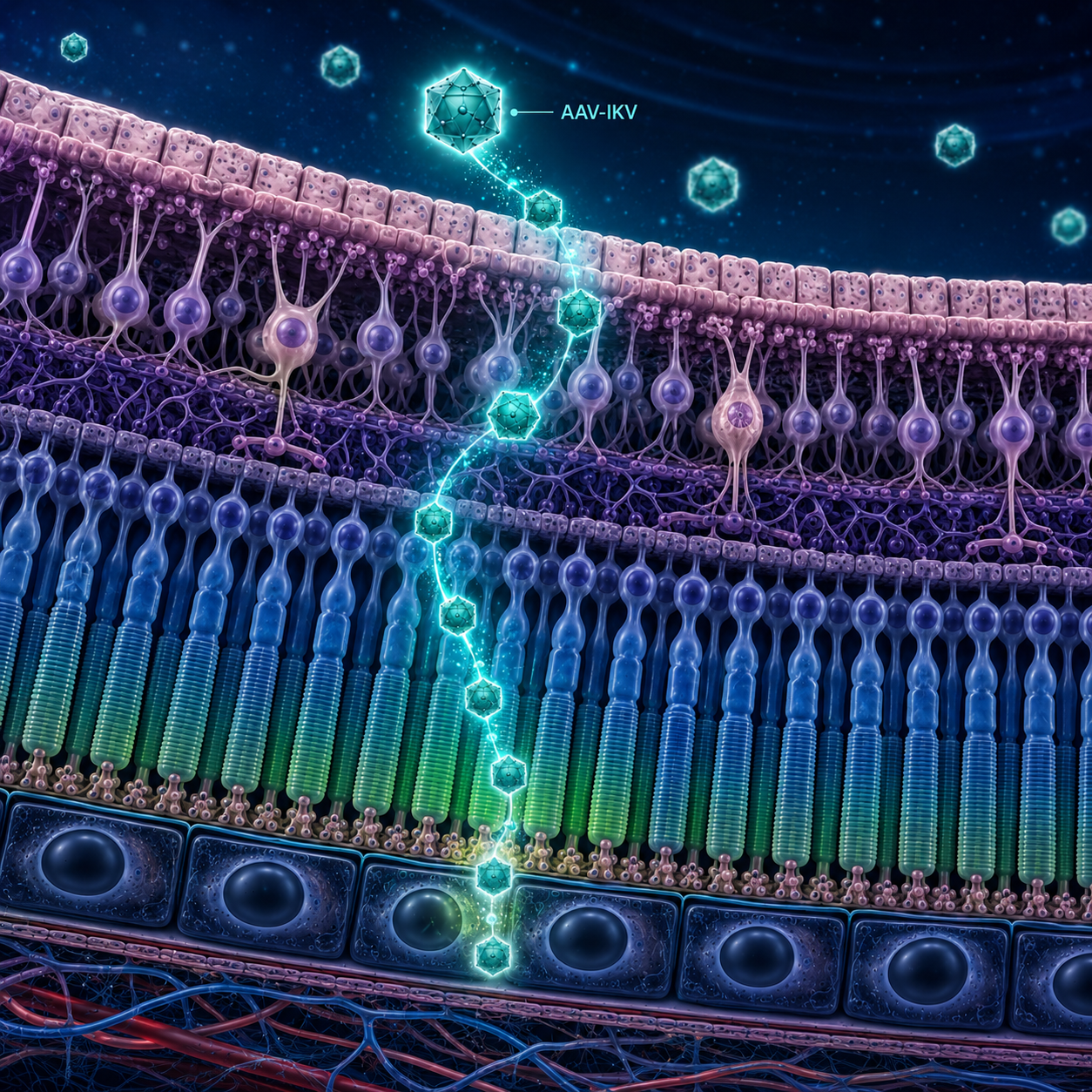
The eye provides local routes for administration, but retinal barriers still determine whether a therapeutic payload reaches photoreceptors, RPE, or outflow tissues.
Research packageScientific focus
The programs apply engineered delivery to compartments where disease biology is well characterized: the outer retina in macular degeneration and retinal degeneration, and the trabecular meshwork in glaucoma.
AAV‑IKV is designed for transgene delivery from the vitreous through retinal layers to outer retinal targets, including photoreceptors and RPE.
AAV‑IKV‑Decorin studies address laser‑induced CNV and the fibrotic response, rather than treating angiogenesis as the only disease process.
An undisclosed dry AMD program is focused on local complement modulation, building on Visiogene’s experience in complement biology for geographic atrophy.
AAV‑IKV‑Decorin is being studied for TGFβ2‑driven fibrosis at the trabecular meshwork, a mechanism linked to aqueous humor outflow resistance.
Platform emphasis
The vector platform addresses a central constraint in ocular gene therapy: outer retinal cells are biologically important targets, but conventional vectors delivered into the vitreous generally have limited access to photoreceptors and RPE.
Read about AAV‑IKVAAV‑IKV also provides a delivery framework for anterior segment studies, including intracameral delivery to tissues involved in glaucoma pathophysiology.
Retinal disease program
The wet AMD program uses AAV‑IKV to deliver decorin, a matrix-associated proteoglycan with relevance to angiogenic, fibrotic, inflammatory, and autophagy pathways. The public preclinical work emphasizes both CNV and subretinal fibrosis.
Wet AMD programGlaucoma program
In glaucoma models, AAV‑IKV is used as the delivery layer and decorin as the therapeutic transgene. Endpoints include trabecular meshwork fibrosis, intraocular pressure, retinal ganglion cell integrity, and ocular tolerability observations.
Glaucoma sciencePipeline
Retinal penetrating AAV designed to access outer retinal cell types from the vitreous.
View platform →Decorin delivery studied for effects on neovascularization, fibrosis, inflammation, and autophagy.
View program →Novel local complement targeting for dry AMD, with target and construct details undisclosed.
View program →Anterior segment gene delivery focused on TGFβ2 / decorin biology and trabecular meshwork fibrosis.
View program →Team
Visiogene’s team combines ocular genetics, AAV vector development, retinal degeneration model expertise, and clinical research perspective.
Team